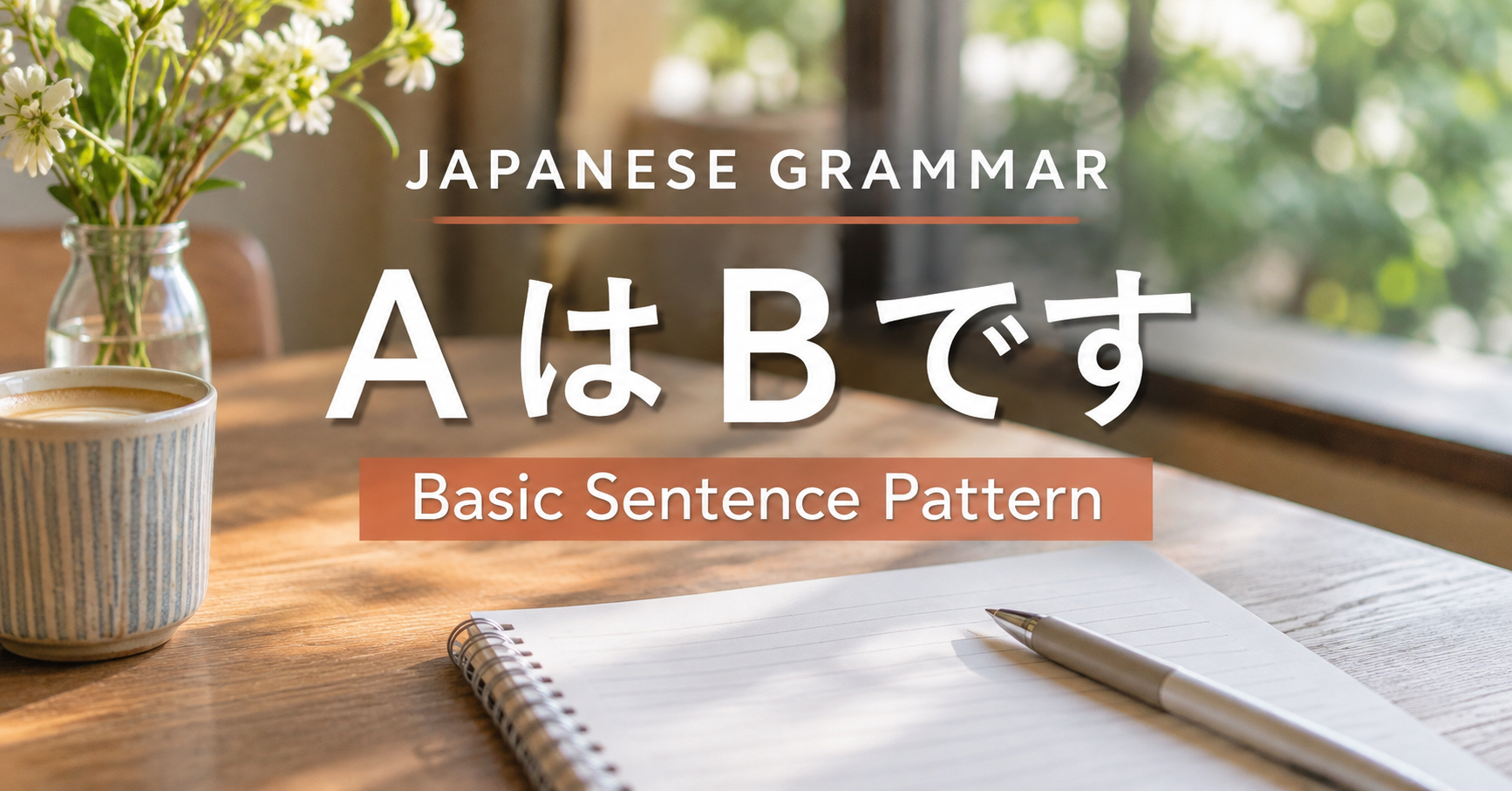
If you’re just starting to learn Japanese, one of the first sentence patterns you’ll come across is A は B です.
It’s a simple but useful pattern that you can use to introduce yourself, describe people and places, and talk about everyday things.
Let’s look at how it works!
How It Works : A は B です
A は B です。
This pattern is often used to say “A is B.”
- A is the topic you’re talking about.
- は (wa) marks the topic of the sentence.
- B gives information about A.
- です (desu) makes the sentence polite.
One important thing to remember: although は is written as ha, it’s pronounced wa when used as a topic particle.
Let’s start with some examples.
Introducing People
🤍 私はエマです。
I am Emma.
🤍 彼はマークです。
He is Mark.
🤍 彼女はソフィアです。
She is Sofia.
🤍 あなたは学生(がくせい)です。
You are a student.
Quick Tip: 彼, 彼女, and 私
Here are three useful pronouns:
- 私(わたし)— I / me
- 彼(かれ)— he / him
- 彼女(かのじょ)— she / her
There’s something interesting about 彼女!
彼女 can mean both “she” and “girlfriend,” depending on the context.
For example:
🤍 彼女は先生(せんせい)です。
She is a teacher.
🤍 彼女は私の彼女です。
She is my girlfriend.
And if you want to say “boyfriend,” you can use 彼氏(かれし).
🤍 彼は私の彼氏です。
He is my boyfriend.
Now it’s your turn!
Try introducing yourself in Japanese.
私は____です。
Replace the blank with your own name.
Describing Places and Things
We can also use A は B です to describe places and things.
Let’s learn a few adjectives.
🤍 この部屋(へや)は大きいです。
This room is big.
🤍 あのカバンは小さいです。
That bag is small.
🤍 この町(まち)は静(しず)かです。
This town is quiet.
🤍 この公園(こうえん)はきれいです。
This park is beautiful.
Quick Tip: Opposite Adjectives
Learning opposite words together can make them easier to remember.
大きい(おおきい)— Big
小さい(ちいさい)— Small
For example:
🤍 この犬(いぬ)は大きいです。
This dog is big.
🤍 あの猫(ねこ)は小さいです。
That cat is small.
Let’s try another pair!
暑い(あつい)— Hot (weather)
寒い(さむい)— Cold (weather)
🤍 夏(なつ)の大阪(おおさか)は暑(あつ)いです。
Osaka is hot in summer.
🤍 冬(ふゆ)の札幌(さっぽろ)は寒(さむ)いです。
Sapporo is cold in winter.
A Little Extra: あつっ! and さむっ!
In casual Japanese, you might hear people say:
- あつっ! — So hot!
- さむっ! — So cold!
These are casual exclamations used when reacting to the heat or cold.
You might also hear あつ! or さむ!
They’re common in everyday spoken Japanese, but they’re not expressions you’d normally use in formal writing.
Talking About Age, People, and Relationships
Let’s practice using the same sentence pattern in different situations.
🤍 私は25歳(さい)です。
I’m 25 years old.
🤍 妹(いもうと)は18歳です。
My younger sister is 18 years old.
🤍 兄(あに)は優(やさ)しいです。
My older brother is kind.
🤍 あの俳優(はいゆう)はかっこいいです。
That actor is good-looking.
🤍 この赤(あか)ちゃんはかわいいです。
This baby is cute.
Quick Tip: Talking About Relationships
🤍 私たちは同僚(どうりょう)です。
We are coworkers.
🤍 彼らは友達(ともだち)です。
They are friends.
🤍 私たちは兄弟(きょうだい)です。
We are siblings.
In Japanese, nouns usually don’t change between singular and plural the way English nouns do.
For example:
友達(ともだち) can mean either “friend” or “friends.”
🤍 リナは私の友達です。
Rina is my friend.
🤍 リナとケンは私の友達です。
Rina and Ken are my friends.
The meaning becomes clear from the context.
Talking About Weather
We can also use this pattern to talk about the weather.
🤍 今日(きょう)は雨(あめ)です。
It’s rainy today.
🤍 明日(あした)は晴(は)れです。
It will be sunny tomorrow.
🤍 今日は曇(くも)りです。
It’s cloudy today.
🤍 外(そと)は寒(さむ)いです。
It’s cold outside.
Notice that Japanese doesn’t always need the same subject as English.
For example, 今日は雨です literally talks about “today,” but a natural English translation is “It’s rainy today.”
Talking About Nationalities
Now let’s practice saying where people are from.
🤍 私はカナダ人(じん)です。
I’m Canadian.
🤍 彼はフランス人です。
He is French.
🤍 彼女はブラジル人です。
She is Brazilian.
🤍 私の先生は中国人です。
My teacher is Chinese.
Quick Tip: Country + 人
In Japanese, you can often add 人(じん) to a country name to describe someone’s nationality.
| Country | Nationality |
|---|---|
| カナダ — Canada | カナダ人 — Canadian |
| フランス — France | フランス人 — French |
| ブラジル — Brazil | ブラジル人 — Brazilian |
| 中国(ちゅうごく)— China | 中国人(ちゅうごくじん)— Chinese |
| イギリス — UK | イギリス人 — British |
Now try making three sentences using the pattern you’ve learned.
私は____です。
彼は____です。
彼女は____です。
You can use names, ages, nationalities, jobs, or adjectives.
Talking About Languages
Let’s learn how to talk about different languages!
You already know:
- 日本(にほん)— Japan
- 日本人(にほんじん)— Japanese person
- 日本語(にほんご)— Japanese language
The kanji 語(ご) means “language” when used in words like 日本語.
But not every language name is made by simply adding 語 to a country name.
For example, English is 英語(えいご), not アメリカ語.
Here are some useful language names.
| Language | Japanese |
|---|---|
| Japanese | 日本語(にほんご) |
| English | 英語(えいご) |
| Spanish | スペイン語 |
| French | フランス語 |
| Chinese | 中国語(ちゅうごくご) |
| Korean | 韓国語(かんこくご) |
Let’s use these words in sentences!
🤍 中国語は難(むずか)しいです。
Chinese is difficult.
🤍 フランス語は面白(おもしろ)いです。
French is interesting.
🤍 スペイン語は楽(たの)しいです。
Spanish is fun.
🤍 英語は便利(べんり)です。
English is useful.
Quick Tip: Changing the Topic
The great thing about this grammar pattern is that you can change A to talk about something else.
For example:
面白い(おもしろい)— Interesting
🤍 この映画(えいが)は面白いです。
This movie is interesting.
難しい(むずかしい)— Difficult
🤍 この問題(もんだい)は難しいです。
This question is difficult.
簡単(かんたん)— Easy
🤍 このゲームは簡単です。
This game is easy.
See? You can use the same sentence pattern with lots of different topics.
Your Turn!
Now it’s your turn to use A は B です!
Part 1: Complete the Sentences
Fill in the blanks using your own information.
- 私は____です。
I am ______. - 私の友達は____です。
My friend is ______. - 私の町は____です。
My town is ______. - 今日は____です。
Today is ______. - ____語は面白いです。
______ is an interesting language.
Part 2: Translate into Japanese
Try making Japanese sentences using the grammar you’ve learned.
- My younger sister is 20 years old.
- This park is big.
- He is Canadian.
- Today is sunny.
- Spanish is interesting.
Check Your Answers
- 妹は20歳です。
- この公園は大きいです。
- 彼はカナダ人です。
- 今日は晴れです。
- スペイン語は面白いです。
Ready to Ask Questions in Japanese?
Now that you know how to make simple sentences with A は B です, why not try turning them into questions?
In the next lesson, you’ll learn how to use か to ask questions in Japanese, including polite and casual ways of speaking.
Read Next: How to Ask Questions with か
Wrapping Up
Today, we practiced one of the most useful basic Japanese sentence patterns:
A は B です。
You can use it to introduce yourself, describe people and places, talk about the weather, and share simple information about nationalities and languages.
Try making a few sentences about your own life using the words you’ve learned.
You don’t need complicated grammar to start communicating in Japanese. Start with simple sentences and build from there!
Want to Learn Japanese with Me?
If you’d like to practice Japanese with a teacher, you can learn more about my online Japanese lessons here.