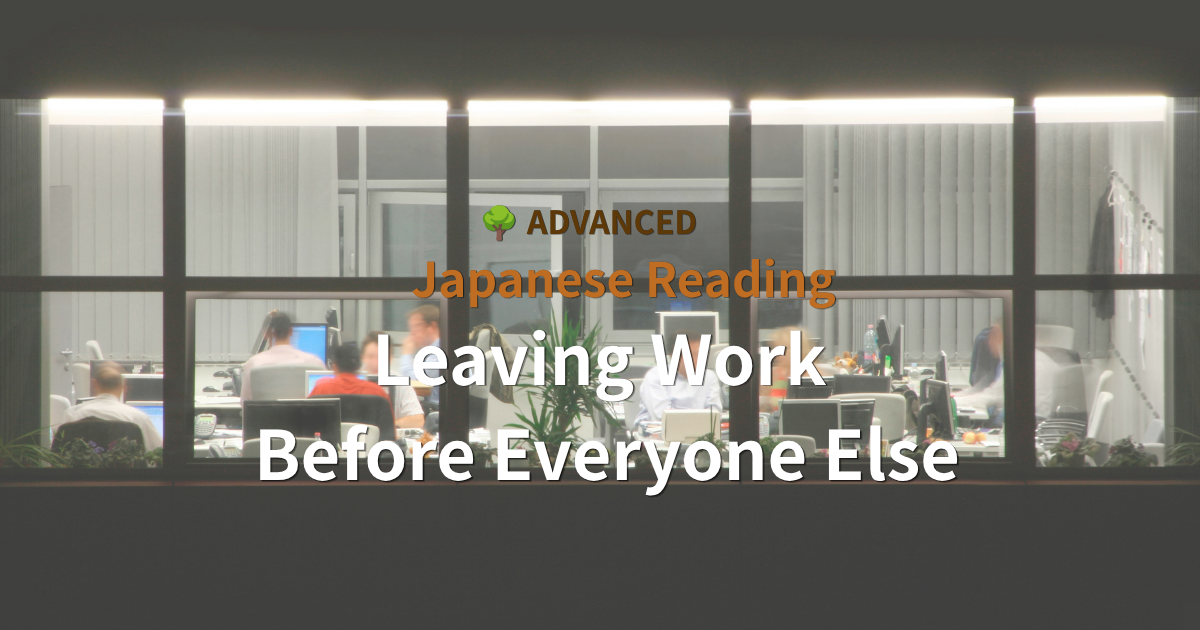
Practice your Japanese reading with a story about a common workplace situation in Japan: finishing your work while the people around you are still busy.
This reading is designed for advanced learners, around JLPT N2–N1 level. Through an everyday situation at work, you’ll explore the balance between being considerate of others and protecting your own time.
🌳 Advanced · JLPT N2–N1
Japanese Reading

私の職場では、帰る時間は人によってかなり違う。
自分の仕事が終われば帰っても問題ないのだが、周りが忙しそうにしていると、「お先に失礼します」と言うのをためらうことがある。
以前、同僚にその話をすると、「やることが終わったなら、気にせず帰ればいい」と言われた。
一方で、誰かが明らかに困っているなら、少しくらい手伝ってから帰るのも自然ではないか、と考える人もいる。
私も、周囲への配慮は必要だと思う。
ただ、毎回「みんなが残っているから」という理由だけで帰るのを遅らせていたら、自分の時間を犠牲にすることにもなりかねない。
そもそも、誰かに残るよう求められているわけではなく、自分で勝手に帰りにくい雰囲気を感じ取っているだけの場合もある。
早く帰ることと、周りを気にかけないことは同じではない。
必要なときには助け合いながら、自分の仕事が終わった日は帰る。
その判断を周囲の様子だけに任せず、自分なりの基準を持つことも必要なのかもしれない。
Comprehension Questions
- 筆者は、自分の仕事が終わっていても、どのようなときに帰るのをためらいますか?
- 筆者の同僚は、帰ることについてどのように考えていますか?
- 筆者は、どのような場合なら少し手伝うことも自然だと考えていますか?
- 筆者は「帰りにくい雰囲気」について、どのような可能性に気づいていますか?
- 最後の段落から、筆者は仕事を終えて帰る判断について、何が大切だと考えていることが分かりますか?
Vocabulary
- 職場(しょくば) — workplace
- ためらう — to hesitate
- 同僚(どうりょう) — coworker / colleague
- 明らかに(あきらかに) — clearly / obviously
- 配慮(はいりょ) — consideration
- 犠牲にする(ぎせいにする) — to sacrifice
- ~かねない — could possibly / might result in
- そもそも — in the first place
- 求める(もとめる) — to ask / expect
- 雰囲気(ふんいき) — atmosphere
- 感じ取る(かんじとる) — to sense / perceive
- 気にかける(きにかける) — to care about / be concerned about
- 判断(はんだん) — judgment / decision
- 基準(きじゅん) — standard / criterion
- 助け合う(たすけあう) — to help one another
Useful Expressions
1. ~ても問題ない — there is no problem with / it is okay to
自分の仕事が終われば帰っても問題ないのだが、周りが忙しそうにしていると、「お先に失礼します」と言うのをためらうことがある。
There is no problem with leaving once my work is finished, but when everyone around me looks busy, I sometimes hesitate to say, “Excuse me for leaving before you.”
Use this expression when something is permitted or would not cause a particular problem.
・予定がなければ、今日は少し早く帰っても問題ない。
If you don’t have anything scheduled, there’s no problem with leaving a little early today.
2. ~くらい — at least / something as small as
誰かが明らかに困っているなら、少しくらい手伝ってから帰るのも自然ではないか、と考える人もいる。
Some people feel that if someone is clearly struggling, it is only natural to help out a little before leaving.
Here, ~くらい presents an action as relatively small or reasonable in the situation.
・忙しいときは、準備くらい手伝ってもいいと思う。
When things are busy, I think I can at least help with the preparations.
3. ~かねない — could possibly / might result in
自分の時間を犠牲にすることにもなりかねない。
It could end up meaning that I sacrifice my own time.
Use this expression when there is a possibility of an undesirable or concerning result.
・無理を続ければ、体調を崩しかねない。
If you keep pushing yourself too hard, you could end up becoming unwell.
4. ~わけではない — it does not mean that / it is not the case that
誰かに残るよう求められているわけではなく、自分で勝手に帰りにくい雰囲気を感じ取っているだけの場合もある。It isn’t necessarily that someone is asking me to stay; sometimes I may simply be sensing an awkwardness about leaving on my own.
Use this expression to correct an assumption or show that something is not necessarily as it appears.
・早く帰る人が仕事に責任を持っていないわけではない。Leaving work early does not mean that someone is irresponsible about their job.
English Translation
At my workplace, the time people leave varies quite a bit. There is no problem with going home once my work is finished, but when the people around me look busy, I sometimes hesitate to say, “Excuse me for leaving before you.”
When I mentioned this to a coworker once, they told me, “If you’ve finished what you need to do, just go home without worrying about it.” On the other hand, some people think that if someone is clearly struggling, it is only natural to help out a little before leaving.
I also think it is important to be considerate of the people around me. But if I delay going home every time simply because everyone else is still there, I could end up sacrificing my own time. In the first place, sometimes no one is actually asking me to stay; I may simply be sensing an awkwardness about leaving on my own.
Leaving early and not caring about the people around you are not the same thing. We can help each other when necessary while still going home on days when our own work is finished. Perhaps it is also important to have our own standards for making that decision instead of leaving it entirely up to what everyone else seems to be doing.