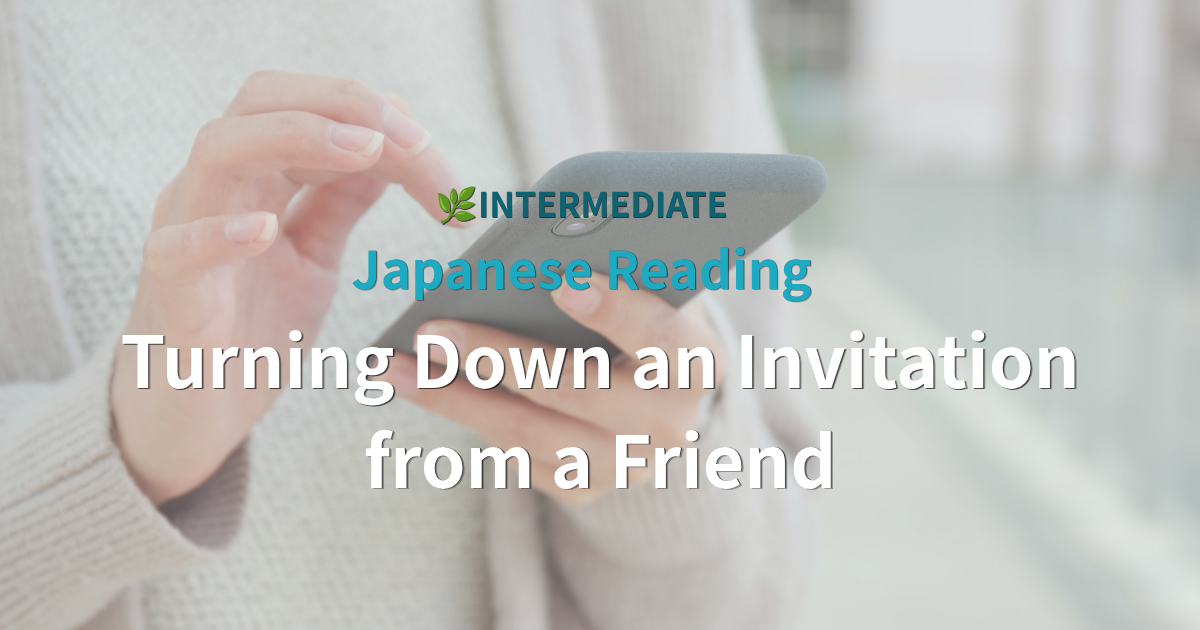
Practice your Japanese reading with a story about deciding whether to accept an invitation from a friend.
This reading is designed for intermediate learners, around JLPT N4–N3 level. The sentences are a little longer than the beginner readings, with more expressions for thinking, explaining, comparing, and making decisions.
🌿 Intermediate · JLPT N4–N3
Japanese Reading
金曜日の夜、友達のユキからメッセージが来ました。
「日曜日、みんなで新しくできたカフェに行くんだけど、一緒に行かない?」
私はそのカフェが気になっていたので、最初はすぐに「行く!」と返事をしようと思いました。
でも、その週は仕事が忙しく、毎日帰る時間が遅くなっていました。
土曜日にも予定があったため、日曜日まで出かけると、ゆっくり休む時間がほとんどありません。
最近、疲れているのに無理をして出かけて、次の日に後悔することが何度かありました。
そのため、今回は家で休んだほうがいいかもしれないと思いました。
とはいえ、せっかく誘ってくれたのに断るのは少し申し訳ない気がします。
それに、最近ユキとはなかなか会えていませんでした。
しばらく迷ったあと、私は正直に伝えることにしました。
「誘ってくれてありがとう。行きたいんだけど、今週はちょっと疲れていて、日曜日は家で休もうと思ってる。
また今度、一緒に行けたらうれしい!」
メッセージを送ったあと、「断って大丈夫だったかな」と少し心配になりました。
しかし、すぐにユキから返事が来ました。
「もちろん!無理しないでゆっくり休んでね。
また別の日に行こう!」
そのメッセージを読んで、私はほっとしました。
行きたい気持ちがあっても、いつも予定を入れる必要があるわけではありません。
自分の体調や忙しさを考えて断ることも、ときには大切だと思いました。
Comprehension Questions
- ユキは日曜日に何をしようと誘いましたか?
- どうして「私」は最初、すぐに誘いを受けようと思いましたか?
- 「私」が日曜日に出かけるかどうか迷った理由は何ですか?
- 最近、「私」は無理をして出かけたあと、どう感じることがありましたか?
- 「私」は、なぜ誘いを断ることを少し申し訳なく感じましたか?
- ユキから返事が来たあと、「私」はどんな気持ちになりましたか?
- この経験から、「私」はどんなことが大切だと思いましたか?
Vocabulary
- 誘う(さそう) — to invite
- 返事(へんじ) — reply / response
- 忙しい(いそがしい) — busy
- 予定(よてい) — plan / schedule
- 疲れる(つかれる) — to get tired
- 無理をする(むりをする) — to push oneself / overdo it
- 後悔する(こうかいする) — to regret
- 申し訳ない(もうしわけない) — to feel sorry / apologetic
- せっかく — with effort / when someone has kindly done something
- 正直に(しょうじきに) — honestly
- 伝える(つたえる) — to tell / communicate
- 断る(ことわる) — to decline / turn down
- 心配する(しんぱいする) — to worry
- ほっとする — to feel relieved
- 体調(たいちょう) — physical condition / how you are feeling
Useful Expressions
1. ~たほうがいい — it might be better to / should
今回は家で休んだほうがいいかもしれないと思いました。
I thought it might be better to stay home and rest this time.
Use ~たほうがいい when saying that one choice or action seems better than another. It is often used for advice, but it can also describe a decision you are considering for yourself.
・今日は早く寝たほうがいいと思います。
I think I should go to bed early today.
2. ~ことにする — to decide to do
私は正直に伝えることにしました。
I decided to tell her honestly.
Use ~ことにする when you make a decision yourself. In the past form, ~ことにした, it means that you decided to do something.
・今年は毎日少しずつ日本語を勉強することにしました。
I decided to study a little Japanese every day this year.
3. ~のに — even though / although
最近、疲れているのに無理をして出かけて、次の日に後悔することが何度かありました。
Recently, there had been several times when I went out even though I was tired and regretted it the next day.
Use ~のに when the result is different from what you might normally expect. It can also show feelings such as disappointment or frustration.
・早く家を出たのに、電車に間に合いませんでした。
Even though I left home early, I didn’t make the train.
4. ~ことがある — there are times when / sometimes
次の日に後悔することが何度かありました。
There had been several times when I regretted it the next day.
Use ~ことがある to talk about something that happens sometimes or has happened on certain occasions.
・忙しい日は、昼ご飯を食べる時間が遅くなることがあります。
On busy days, there are times when I eat lunch late.
5. ~わけではない — it doesn’t mean that / it’s not necessarily the case that
いつも予定を入れる必要があるわけではありません。
It doesn’t mean that you always have to make plans.
Use ~わけではない when you want to say that something is not always or necessarily true. It is useful when making a statement less absolute.
・日本語が話せるからといって、漢字が全部読めるわけではありません。
Just because someone can speak Japanese doesn’t mean they can read every kanji.
English Translation
On Friday evening, I got a message from my friend Yuki.
“We’re all going to a newly opened café on Sunday. Do you want to come with us?”
I had been interested in the café, so at first I was about to reply, “Yes!” right away.
But work had been busy that week, and I had been getting home late every day. I also had plans on Saturday, so if I went out on Sunday too, I would have almost no time to relax.
Recently, there had been several times when I pushed myself to go out even though I was tired and regretted it the next day. Because of that, I thought it might be better to stay home and rest this time.
Still, I felt a little bad turning down the invitation when Yuki had gone to the trouble of inviting me. On top of that, I hadn’t had many chances to see her recently.
After thinking about it for a while, I decided to be honest with her.
“Thanks for inviting me. I’d like to go, but I’m a little tired this week, so I think I’m going to stay home and rest on Sunday. I’d be happy if we could go together another time!”
After sending the message, I started to worry a little and wondered if it had been okay to say no.
However, Yuki replied almost immediately.
“Of course! Don’t push yourself, and get some rest. Let’s go another day!”
I felt relieved when I read her message.
Even when I want to go somewhere, I don’t always have to fill my schedule with plans. I realized that sometimes it’s important to consider how I’m feeling and how busy I am and decide to say no.